

Workplace Safety
Workplace Safety is a budding but passionate interest of mine. I am planning to begin working towards an Associate Safety Professional certification from the Board of Certified Safety Professionals upon the completion of my bachelor’s degree in Technical Writing. I’ve worked in industrial facilities for several years, specifically a paper mill and a heat treatment plant. It was at the paper mill that I first became engaged with the plant’s safety culture; WestRock used SafeStart, and their safety manager, Christopher Bugajski, was someone who led by example. He and I spoke several times about safety culture and how to live it, and I credit him for my initial interest in workplace safety.
Later, when I went on to work in heat treatment, the heat treater lifestyle taught me many things about safety—mainly that you should just be prepared to use safety knowledge and react quickly when the job involves fire as a tool. I’ve joked before that you need to respect fire when you work with it so that it will respect you back, but it’s true. I used fire extinguishers daily, wore flame-proof clothing, handled natural gas and flame wands regularly, and had to be prepared to quickly put on PPE and reach into flame curtains to safely get a load out of a furnace. It was fast-paced and intense, but you learned how much safety mattered. Wrong moves or unsafe work practices could mean someone doesn’t go home to those they love.
Further, that also ended up applying to CPR and First Aid training. First obtaining this at WestRock, I renewed my certification every time at the heat treat, and eventually, had to use the training in a real-life scenario when a truck driver had a heart attack only a few minutes after his arrival to our plant. Reacting quickly, I ran and grabbed the defibrillator and began compressions, and my coworker on the floor helped me put the defibrillator together while another called 911. The defibrillator worked perfectly, guiding me through the resuscitation process while we awaited police and EMTs. The coworker who helped me start it quickly got on a forktruck and cleared the area of all surrounding pallets and obstacles. Police arrived within minutes, and within an hour, everyone had left, including managers, police, and the EMTs, who gave us props for how we handled things. I later learned Daryl had a heart attack, and was hospitalized in the US for a month before his return to his home in Canada. His family, who came down to visit him while here, gave us each a gift bag as a thank you. I still use my Canada mug almost every day. I’m happy to know he went home with his family.
It’s not just about abiding by OSHA. It’s not just about following the rules and ensuring employees are too. It means ensuring that your employees are engaged in safety—that they don’t just see it as part of the job, that they don’t warn each other when the safety manager is on the production floor, and that they see safety as more than just at the workplace. Safety is everyone’s job—and if three people can come together to start CPR, call 911, and clear the area, then people can come together and ensure plants are safe, employees care about each other, and no one is unprepared. There’s a lot more I could say, but I’ll leave you with a thought that Mr. Bugajski shared with me: Have the respect to interrupt someone who working unsafely; don’t wait for them to get hurt. Having respect for each other is a huge aspect of workplace safety, and I hope to always reflect this in my behavior. Having empathy and understanding of your fellow humans is a great place to start when preaching a culture of safety, and I aim to ensure that safety is never seen as a punishment—rather, it’s seen as a way to make sure that everyone gets to go home every day the same way they came in.
Writing
Writing is, clearly, quite important to me. I write a lot about everything I write about; being concise is a struggle for me, and the urge to explain everything is one I have to fight. I will say, though, that the editing process is one of my favorites, and testing how much information you can remove while preserving functionality is a fun practice of its own. However, more importantly, writing to ensure everyone can understand it, no matter how wordy or concise, means everyone is treated fairly; everyone can understand standard operating procedures, everyone can understand the policies of a company, and everyone can understand their rights, their views, and their own philosophies. Clarity and accessibility become basic ethics when you realize everyone learns and interprets information differently.
Not everyone is the same; everyone is different. I’ve worked with people from all sorts of backgrounds, and I have never met anyone who isn’t smart in some kind of way. It’s not a matter of intelligence; some people just need pictures to be able to read about a task and understand it. Some people need steps written out to be able to follow them. When you consider what someone might need in order to do something, writing a bunch of standard operating procedures suddenly becomes a second nature; the inclusion of clear photographs, standardized layouts, and the conversational but clear tone become easier the more you practice—and the more you consider the fact that every technical document you write is, truly, speaking to the reader in one way or the other, the more you write the way you would speak to someone.
I never want someone to be left out of learning their tasks. I never want someone to be left out of reading the news or reading about current events. I never want someone to be left out of life just because they learn differently, have a disability, or have a different background than I do. Everyone deserves access to essential information. When I write, I aim to provide information in a way that everyone can understand, with no imperative information left out, and with clear, understandable points—whether I’m writing a technical document, a poem, an essay, or even a political piece. I’m not here to leave people out of conversations, out of learning, or out of life just because they’re different from me. I aim to include everyone, and I strive to live that way every day of my life. I say I write the way I speak because I do; I speak to people with kindness, understanding, and acceptance, and I write in a way that reflects that. Ease-of-use is not just a basic concept to me, but a core one, because everyone deserves documentation that recognizes their humanity. Documentation, and many more aspects of life, should work for everyone.
Writing and Art Ethics
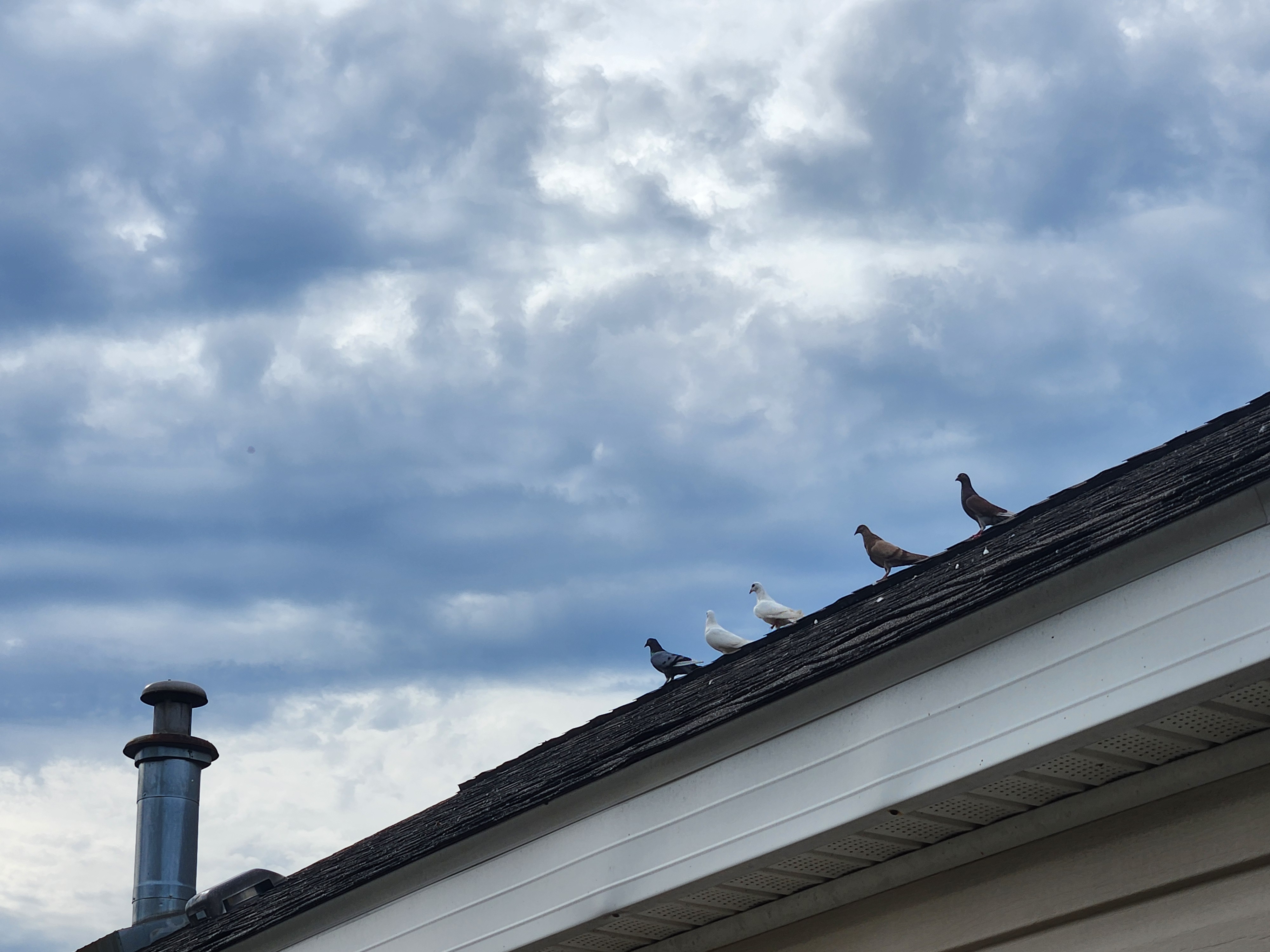
Doves, seen at my mother’s house in Port Byron, NY. An expression of the peace I feel creative activities inspire.
The creative side of me is just as important as the professional side of me, and ethics play a part in both. When it comes to writing, ethics go beyond properly citing sources and ensuring information is verifiable from people with genuine credentials. As someone who enjoys writing poetry and essays, and further, painting and photography, I feel that art and writing need to come from people; I do not use Artificial Intelligence (AI) in the creation of any writing I do, nor in my photography or other aspects of my life. I don’t prefer to use any grammar editing software either; the way I write reflects how I speak in person, and further, creates my voice as an author. I don’t use AI when creating graphics, and I cite when I use pictures, graphics, or information from others. All writing and images on this site are my own unless it directly says otherwise.
I believe it’s further important to try to hold balanced opinions when writing about hot-button topics. There are many interesting things going on in the world right now, to put it lightly. I try my hardest, especially when writing opinion pieces, to at least be fair and nuanced in my evaluations, regardless of how strong I may feel. With this being the case, as long as my bias is declared within the writing, I will indeed express my opinion—just with the fairness I aim for.
But beyond that, when expressing myself, I am to be genuine in my expression. Even when writing technical documentation, where I try to ensure my audience includes anyone who may struggle with reading or writing, my intentions to include people are from the heart, and do not come from a learned standpoint. My education has allowed me to understand how to include others, but including others in life has always been important to me, no matter the field I’m working in or who I’m interacting with. This also goes for my poetry; most of my poems are attempts to reach out to others and express sentiments others may have felt and never been able to word.
We’re all similar, and we are all human, no matter how much we may fight each other in this world. My art and creativity are here to celebrate and investigate the human perspective, hoping to reach yours in a way that you might’ve needed, the way only another human can, with genuine curiosity and fairness.
 The Work of Andrew J. Anderson